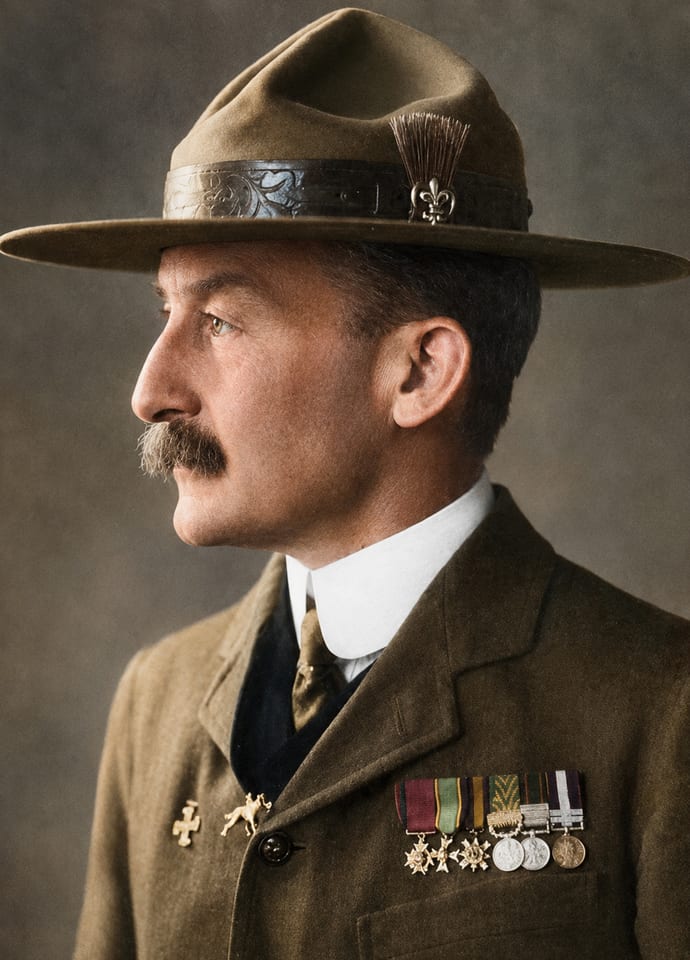
Officer, scout, draughtsman, and storyteller: in 1908 Baden-Powell wrote a book of instruction for boys — and unintentionally founded one of the largest youth movements in the world.
A military handbook for scouts, rewritten for fourteen-year-olds — and out of that detour came a worldwide youth movement.
01
Life & period
Born in London in 1857, Baden-Powell served as a British army officer in India and southern Africa. The siege of Mafeking in 1899–1900 made him famous across the Empire.
In 1907 he tested his idea at a camp on Brownsea Island; the book that set off the movement followed in 1908. He died in Nyeri, Kenya, in 1941.
02
The form
Scouting for Boys is not a treatise but a handbook: campfire yarns, games, tests, maxims, and drawings alternate in short, practical units.
The tone speaks directly to young readers — vivid, demanding, often dryly funny. A translation has to hold exactly that register.
03
Reach and context
Within a few years Scout troops had formed on every continent; the book ranks among the most widely circulated books for young readers of the twentieth century.
It is at the same time a document of the British Empire and carries its worldview plainly. Aeternus preserves the historical wording and makes that context visible rather than smoothing it away.
SeriesGreen Series · Volume 1
First editionLondon, 1908
Source languageEnglish
StatusSubmitted to KDP
New edition
The founding text
The 1908 handbook in full: campcraft, tracking, tests, and yarns — completely translated into German, with the first-edition drawings, 41 new plates, and editorial context. Paperback and hardcover have been submitted to KDP; order links will follow after approval.