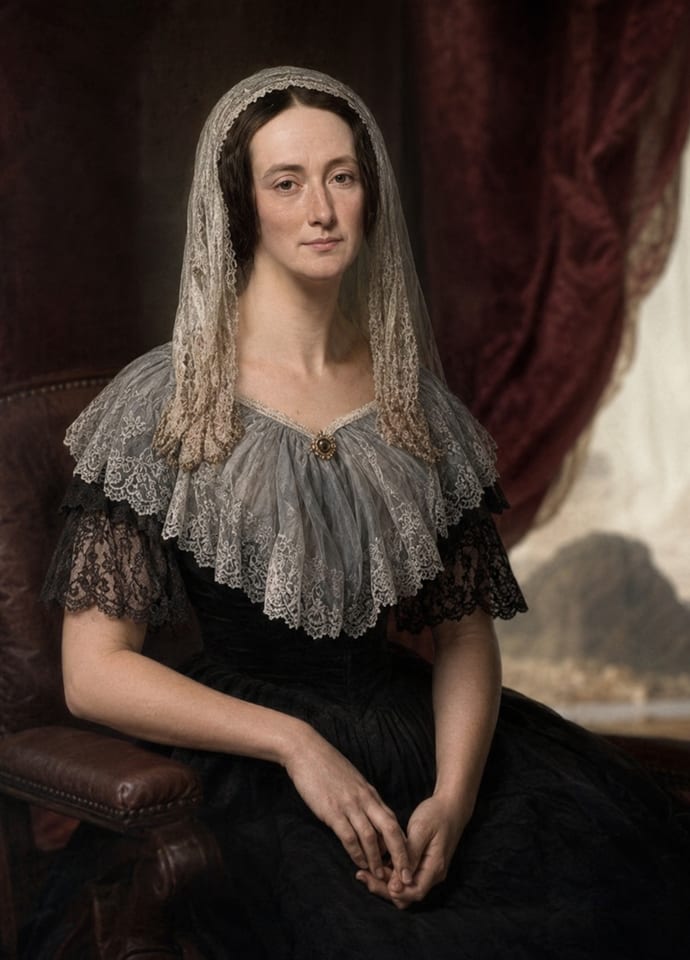
She kept writing in the middle of the catastrophe: day after day Florentia Sale records how a British army in Afghanistan falls apart — soberly, precisely, and without the shelter of later explanation.
A woman at the headquarters of a failing campaign — and the only voice that wrote it down day by day, without knowing how it would end.
01
Life & period
Born Florentia Wynch in 1790, she followed her husband, the British general Sir Robert Sale, to the garrisons of India and finally to Kabul.
She spent the winter of 1841–42 in the besieged cantonment, endured the retreat from Kabul as a wounded woman, and the months that followed in Afghan captivity.
02
The voice
Her text is a true diary, not a retrospective report: first person, often in the present tense of the writing, with dates, marching figures, and names.
She judges her own command sharply and describes cold, hunger, and violence without heroic inflation. Preserving that voice is the central editorial task of the edition.
03
Afterlife
The journal appeared in 1843 from John Murray in London and made her known overnight; the press called her the Grenadier in Petticoats.
Her diary still counts among the most important eyewitness sources for the First Anglo-Afghan War.
SeriesGreen line · Pillar II
First editionJohn Murray, London 1843
FormatsPaperback · Kindle eBook
StatusAvailable from Amazon
Available from Amazon
Tagebuch der Katastrophe
A dated eyewitness diary from the First Anglo-Afghan War, with the appendices and documents of the first edition — translated close to the source and historically contextualized.